How is the HUUM HIVE Wood installed?
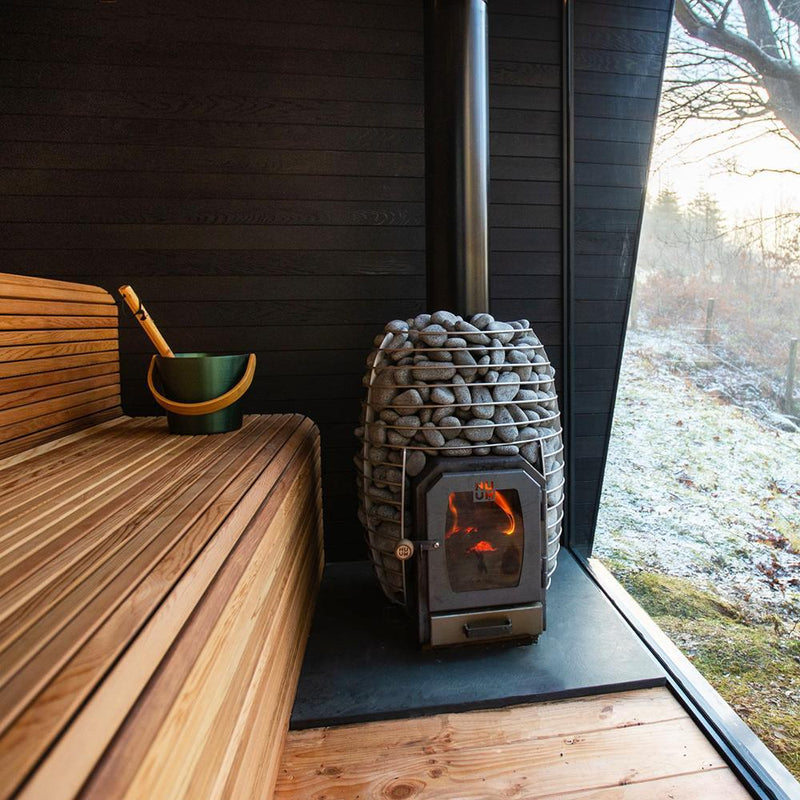
The HUUM HIVE Wood stands on a non-combustible floor strong enough to carry the stove and its 199 or 287 lb of stones, and HUUM's manual says only a specialist may connect it to the chimney; HUUM also recommends a specialist lay the stones. Installation must follow your local building and fire-safety rules.
HUUM HIVE Wood safety distances
Keep at least these distances from the HIVE Wood to combustible materials. HUUM's reflectors, Reflect HM for the HIVE Wood 13 and Reflect H for the HIVE Wood 17 and 17 LS, let the stove sit at half the safety distance from the wall.
HUUM HIVE Wood minimum distances to combustible materials (manual v9, Table 1)
|
HIVE Wood 13 |
HIVE Wood 17 and 17 LS |
| A: each side |
7.48 in (190 mm) |
19.7 in (500 mm) |
| B: behind the stove |
9.8 in (250 mm) |
19.7 in (500 mm) |
| C: in front of the door |
35.5 in (900 mm) |
39.4 in (1,000 mm) |
| Above the stove |
47.3 in (1,200 mm) |
47.3 in (1,200 mm) |
- In a niche of non-combustible material such as stone or concrete, leave at least 4 in (100 mm) between the wall and the stove for air movement
- A single heat barrier halves the distance to combustible materials and a double barrier quarters it; leave at least 1.2 in (30 mm) between the barrier and the surface it protects
- No electrical equipment or wiring may sit inside the stove's safety area
What floor does the HIVE Wood need?
HUUM's manual requires a non-combustible floor with the carrying capacity for the stove and its stones. On a wood or other combustible floor, HUUM's protective bedding increases safety, and HUUM also recommends it over water underfloor-heating pipes: Protective Bed S for the HIVE Wood 13 and Protective Bed L for the HIVE Wood 17. HUUM's bedding is not made for LS models.
What chimney does the HIVE Wood need?
The HIVE Wood's flue outlet is on top of the stove, 4.53 in (115 mm) across. HUUM's manual calls for a T600 chimney with at least 15.81 sq in (10,200 mm²) of cross-section and 12 Pa of draught, joined with metal flue pipes with smooth elbows and venting into its own flue: a flue shared with another furnace is not permitted. Only a specialist may connect the stove to the chimney. Three HUUM chimney kits fit the HIVE Wood:
HUUM's Thru-Wall Backside Connection kit is for the HIVE Flow's rear outlet, not the HIVE Wood. HUUM leaves the chimney's height to local fire-safety regulations; HUUM extension pipes lengthen a kit where needed. Keep the kit's single-wall parts at least 19.7 in (500 mm) and double-wall parts at least 2 in (50 mm) from combustible materials.
Installing the HIVE Wood 17 LS through a wall
- The firebox passes through a non-combustible wall, such as stone or concrete; HUUM recommends insulating the opening with mineral wool or similar
- Leave at least 0.4 in (10 mm) around the firebox for air movement, so add 0.8 in (20 mm) to HUUM's Table 1 height D (18.1 in) and width G (11.8 in) when sizing the opening
- If the floor in front of the firebox door is combustible, install fire-resistant floor protection 23.63 in (600 mm) wider than the door and at least 15.75 in (400 mm) deep
- HUUM's protective bedding is not made for LS models
First firing
Fire the stove outdoors once before installing it: HUUM's manual says the heat-resistant paint on the outer casing gives off an unpleasant odor while it cures during the first firing, and a short piece of flue on the smoke outlet improves the draft. Until then, handle the painted metal carefully to avoid scratches.
Firing and caring for the HIVE Wood
- Burn wood logs only. HUUM finds 11.8 in (30 cm) logs for the HIVE Wood 13 and 15.7 in (40 cm) logs for the HIVE Wood 17 best, 3.1–5.9 in (8–15 cm) across, with some small, easily lit pieces at the start
- Open the ash tray up to 0.4 in (10 mm) while lighting, then close it to 0.08–0.12 in (2–3 mm) depending on the draught, and keep the door closed except to add wood
- If the firebox glows red, the stove is overheating: close the ash tray completely, keep the door shut and, if possible, cut off air to the room. HUUM does not cover metal deformed by overheating
- Empty the ash tray before each firing, clean the stove's heating surfaces at least every 20 uses and have the chimney and flues cleaned at least once a year
- Wash the stones before laying them; HUUM recommends a specialist lay them. Ceramic stones can shorten the stove's life, and crumbled stones should be replaced once a year
- Keep water off the hot door glass, and don't throw salt water, hard water or iron-rich water on the stove
- HUUM gives no fixed heat-up time: it depends on the wall materials, the room's size and the stove's output